Details
Features
About this place
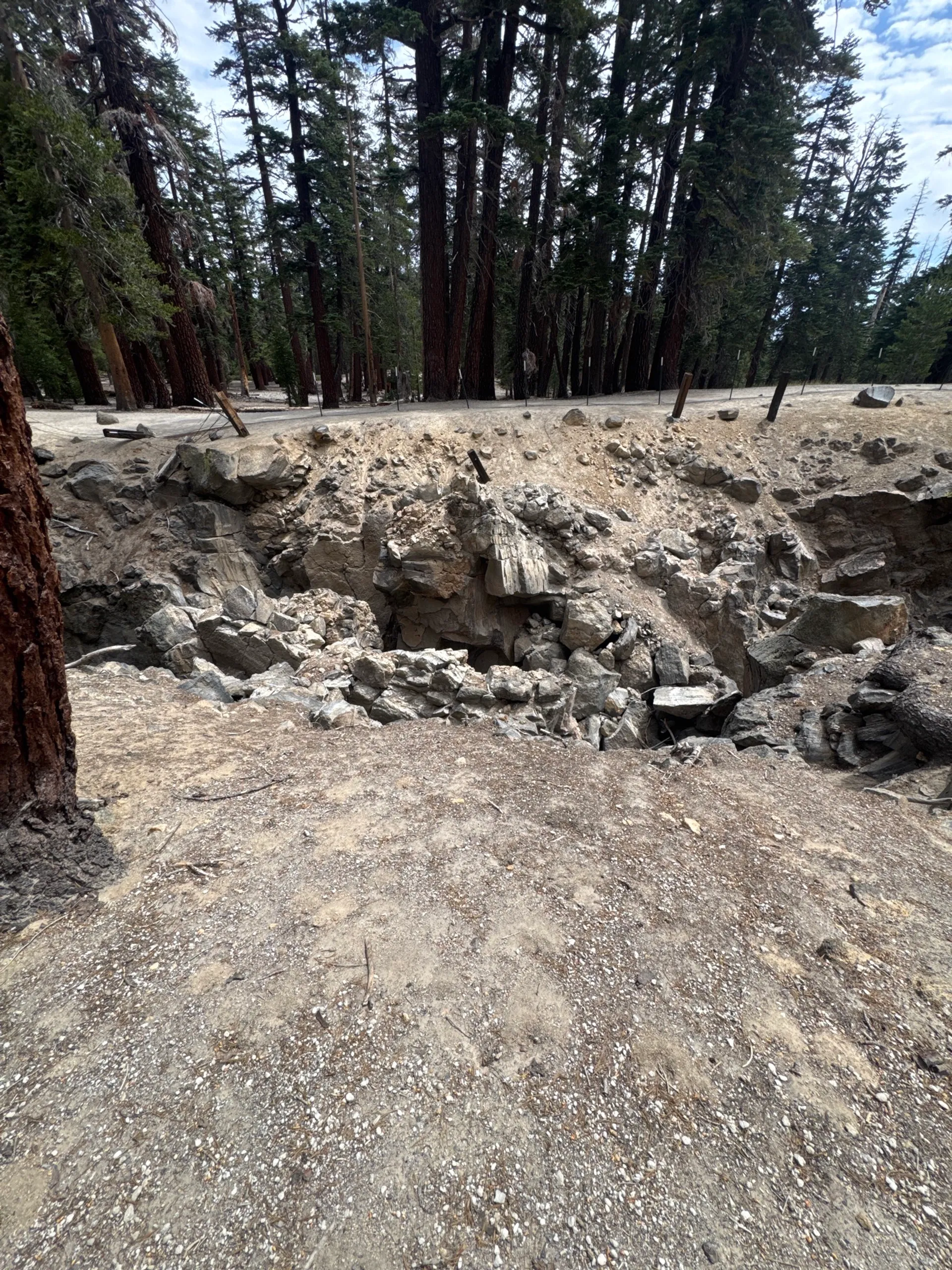
The Earthquake Fault Trail in Mammoth Lakes, California is one of the more unusual short hikes in the Eastern Sierra — a family-friendly loop that lets you walk right up to the edge of a 60-foot-deep volcanic fissure carved into the hardened lava flows of Mammoth Mountain. At just a short flat loop, it's the kind of quick geological wonder that fits perfectly into a Mammoth Lakes trip, whether you're passing through or basing there for a week.
Despite the dramatic name, geologists will tell you this is technically a fissure — not a fault — since the rock on both sides hasn't shifted vertically or laterally. But "Earthquake Fault Trail" makes for a better name, and the crack itself is just as impressive.
The Trail
- Distance: Short easy loop (~0.25 mile)
- Elevation gain: Minimal
- Difficulty: Easy — great for all ages
- Surface: Packed dirt with paved sections; largely ADA-accessible
- Time: 15-30 minutes at a relaxed pace
The loop trail wraps around the perimeter of the fissure, giving you multiple viewpoints down into the crack. Interpretive signs along the way explain the geology, the history, and the ecosystem. Set among towering red fir and Jeffrey pine, it's also one of the more peaceful short walks in the area.
The Fissure Itself
The Earthquake Fault is a nearly straight fracture through volcanic rock — specifically, a hardened rhyolite lava flow that originated from Mammoth Mountain. It's:
- Up to 10 feet wide at the top
- Up to 60 feet deep
- Jagged and un-eroded on both sides, suggesting it's geologically young
- Aligned north-south, lining up with the Inyo-Mono Craters and the Inyo Domes to the north
The exact age is uncertain, but trees growing inside the fissure are at least 160 years old, meaning the crack is at least that old and quite possibly much older. It's believed to have formed as part of the ongoing east-west stretching of the Basin and Range Province — the same tectonic process that's slowly widening much of the western United States.
A Piece of Local History
The fissure has a surprising cultural footnote: because snow could linger year-round in the bottom of the crack, local Native American tribes used it as a natural refrigerator — storing food in the cool depths through the warmer months. It's a beautiful example of how deeply people have understood and used this landscape for hundreds of years.
Volcanic Context
The Earthquake Fault Trail is part of one of the most volcanically active regions in the continental United States:
- Mammoth Mountain (11,053 ft) is an active volcano
- The Long Valley Caldera — a massive volcanic depression — sits just to the southeast
- The Inyo-Mono Craters chain stretches north from here
- CO2 emissions and hot springs in the area are ongoing evidence of activity below the surface
The fissure itself may still be active — someday magma might rise through it, or it might just slowly fill with debris. Nobody knows. That uncertainty is part of what makes this trail worth the stop.
What Else to Do at the Trailhead
The trail area is also a great spot for:
- Picnicking — tables set among the red firs and Jeffrey pines
- Exploring surrounding forest trails — the Inyo National Forest has many connecting paths
- Photography — the fissure, the towering pines, and the volcanic rock textures all photograph well
- Geology-nerd deep-dive — bring a field guide or a curious kid; it's one of the most accessible geology lessons in the Sierra
Best Time to Visit
- Summer (June–September): Prime season — trails are snow-free and easily accessible
- Fall (October): Beautiful with turning aspens nearby, cooler temperatures, fewer crowds
- Winter (November–April): Access is often limited by snow — the road is typically closed in winter and the trail may be inaccessible or require snowshoes
- Spring (May): Depending on snowpack, may still be inaccessible into late May
What to Bring
- Water — even a short walk at 8,000+ ft elevation demands hydration
- Sun protection — altitude means intense UV even on cool days
- Comfortable walking shoes — nothing technical, but good grip helps
- A curious kid — the fissure is genuinely fascinating and the trail is short enough for young hikers
- Camera — the fissure and surrounding forest are photogenic
Practical Info
- Location: Off Mammoth Scenic Loop road, Mammoth Lakes, CA
- Land manager: Inyo National Forest / USDA Forest Service
- Fees: Free — no permit required
- Parking: Free small paved lot at the trailhead
- Restrooms: Vault toilets on-site
- Dogs: Welcome on leash
- Accessibility: Portions of the trail are ADA-accessible
- Season: Late spring through fall (road typically closed in winter)
- Cell service: Limited — download offline maps before going
Pair It With
The Earthquake Fault Trail makes a great quick stop as part of a broader Mammoth Lakes day. Combine with:
- Devils Postpile National Monument — extraordinary columnar basalt formations, ~15 min south
- Rainbow Falls — a 100-foot waterfall accessible from Devils Postpile
- Inyo Craters — another short walk to nearby volcanic features
- Mono Lake — ~30 min north, one of California's most surreal landscapes
- Convict Lake — dramatic alpine lake ~20 min south
- Mammoth Mountain gondola — ride to 11,053 ft for panoramic views
- Hot Creek Geological Site — steaming natural hot springs
- Mammoth Lakes Basin — Twin Lakes, Lake Mary, Horseshoe Lake for boating/fishing/hiking
Why It's Worth the Stop
For anyone visiting Mammoth, the Earthquake Fault Trail delivers something rare: a genuinely interesting natural feature you can experience in 30 minutes, with zero effort, that teaches you something about how the landscape you're standing on was formed. It's the kind of stop that turns a road trip into an actual geological education — without asking anyone to hike a big mountain to earn the payoff.